for venues
Let your building’s common area earn.
Installation, operation, insurance and maintenance sit with mecrai. You take a share of every campaign.
Residential complexes
The in-cabin screen is the one surface residents see several times a day. Sound and brightness are calibrated to the cabin, and your own building announcements live on the same screen.
- One screen per cabin, a sound level suited to a shared space
- A reserved slot for building announcements — dues, meetings, maintenance
- No camera
- Support for the owners’ assembly decision process
Office towers
A dense, regular audience: the same people, every day, at the same hours. A new revenue line for building management and an announcement surface for tenants.
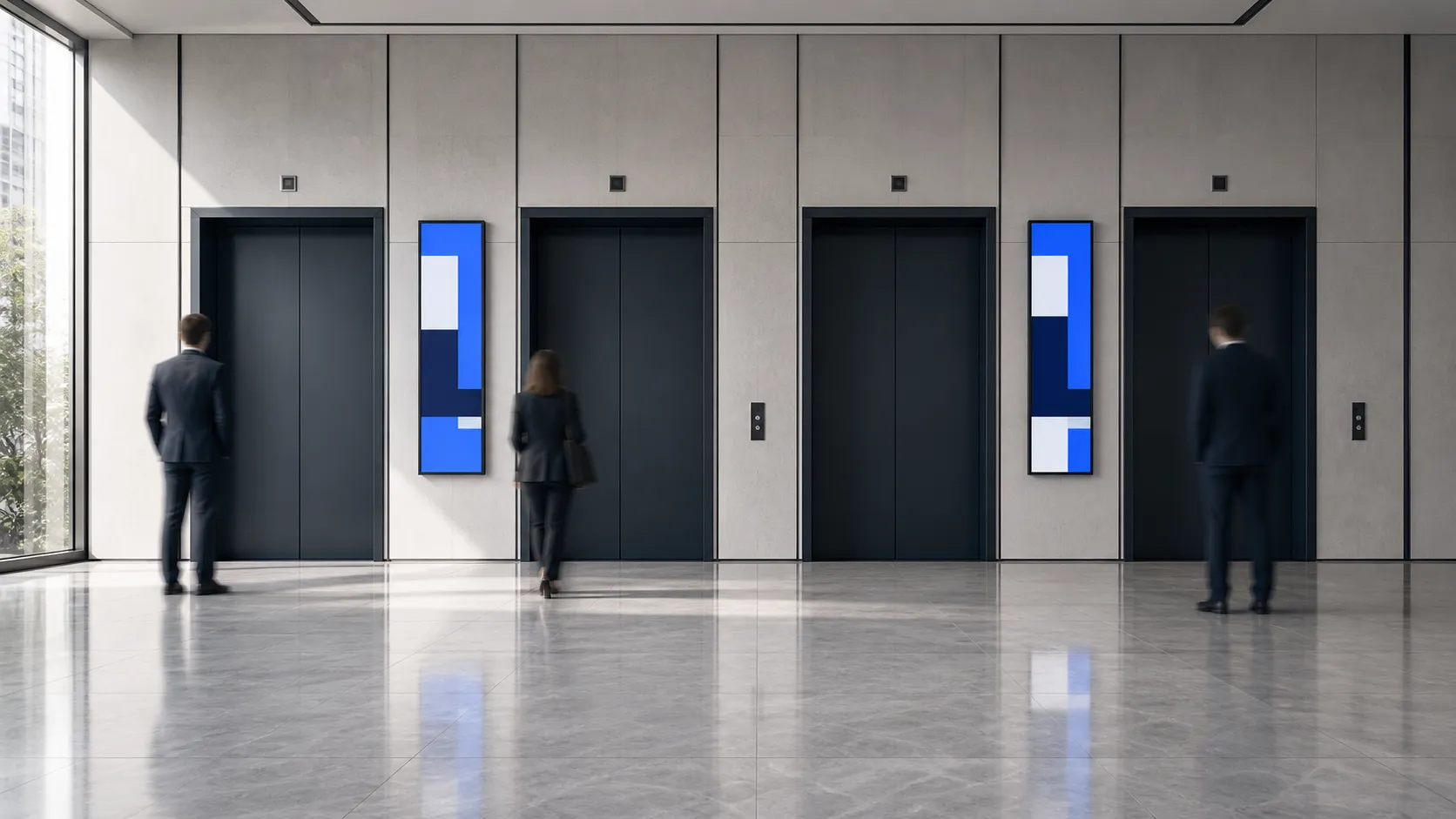
- Screens in the elevator hall and inside the cabin
- A reserved slot for tenant announcements
- A new revenue line for building management
- Content veto suited to corporate tenants
Shopping malls
Screens placed inside the shopping moment, at corridor and elevator touchpoints. The sound level is set against the corridor’s own noise floor.
- Corridor totems and elevator touchpoints
- Sound set against the corridor’s noise floor
- Your own slot for centre campaigns
- Category rules that avoid clashing with tenant brands
process
Four steps.
- 01
Survey and eligibility
We talk through your portfolio: how many buildings, how many cabins, which locations. Technical eligibility is confirmed on site.
- 02
Zero-cost installation
Hardware, fitting, insurance and maintenance sit with mecrai. Not a single line item lands on the building.
- 03
Operation
Content management, maintenance and technical support are ours. When something breaks, there is one place to call.
- 04
Monthly report and share
A transparent report of what ran on your screens, and alongside it your share of the campaign revenue from that location.
what you get
The line items that enter the contract.
- A share of campaign revenue
- The rate is set against your portfolio and settled in the proposal. We do not publish a single number here, because there is no single right number.
- Your own announcement slot
- Your building, complex or centre announcements run on the same screen, in time reserved for you.
- Playout report
- You see what ran on your screens and how long it stayed on air.
- Content veto
- A category you do not want never runs. Excluded categories are named explicitly in the contract.
fitting the space
The screen behaves according to where it is.
A screen entering a shared space raises two questions above all others: will it be noisy, will it glare. The answer to both is that it adjusts — a fixed level is wrong for every venue.
- Sound level
- Sound is never played at a disturbing level; the level is set per venue. In residential the calm of a shared space is preserved; in a mall the opposite problem applies — it has to stay audible over the corridor’s own noise floor.
- Screen brightness
- Brightness adjusts automatically to ambient light: it never glares inside a cabin at night and stays readable in a bright hall by day. The setting a resident never notices is the right setting.
your share
How is your share set?
The share is calculated from the revenue of campaigns played at your venue. Three things set the rate.
Share your portfolio and we will prepare a proposal for you.
- 01
Number of screens and cabins
Portfolio size moves it directly: more touchpoints, more inventory to sell.
- 02
Location and audience density
Daily ride count and the district the venue sits in determine what the inventory is worth to an advertiser.
- 03
Contract term
A longer partnership extends the payback period on the installation, which works in the venue’s favour.
legal
We know the owners’ assembly process.
Installing a screen in a residential complex requires a decision by the owners’ assembly. We prepare that process on your behalf.
- We draft the agenda item, the decision text and the consent templates
- Law no. 7579 eased decision-making in multi-block developments
- Management company or owner — whichever you are, we run the process with you
trust
Everything that enters a shared space has a limit.
No face recognition. No personal records. It only counts. Compliant with KVKK, Türkiye's data-protection law.
- There is no camera in residential buildings.
- Insurance and maintenance are ours; a fault never reaches your agenda.
- The content veto belongs to the venue.
questions
The six things managers ask first.
- Who chooses the content — do I have a veto?
- mecrai builds the playout plan; the veto belongs to the venue. Categories you do not want are excluded from the start in the contract.
- How long is the contract, and what if I want out?
- The term is settled in the proposal. Exit conditions are written explicitly into the contract; the screens are ours, and at the end of the term they are removed at our cost.
- Who is responsible for faults and maintenance?
- mecrai. Hardware, fitting, insurance, maintenance and technical support are our obligation. Building management does not need a technical team.
- Is there a camera?
- Not in the residential segment. And when our measurement layer arrives the principle does not change: no face recognition, no personal records, it only counts.
- Is an owners’ assembly decision required?
- In residential complexes, yes. We prepare the agenda item, the decision text and the consent templates; you do not run the process alone.
- Does the installation cost the building anything?
- No. Hardware, fitting, insurance and maintenance sit with mecrai.
selectivity
Not every building — the right building.
Keeping the first wave small is a choice, not a capacity limit. A screen is worth what its location makes it worth, not how many of it there are.
- We pick a portfolio by daily ride density, not by headcount of screens
- High repetition across a few touchpoints beats scattered contact across many
- We talk to every venue individually — installation is not a form to fill in
proposal
Tell us about your portfolio.
A short form, and then we prepare a proposal for you.
First wave 2026: a limited number of premium portfolios.